
The short answer
- Payoneer describes itself as a Money Service Business registered with FinCEN and a licensed money transmitter under the laws of various U.S. states. It is not a bank.
- Payoneer's terms forbid using its billing tools to get paid for goods or services sold to consumers, and its payment request tool is not a checkout for an online store.
- Payoneer states that fees for receiving accounts vary by country and currency. The exact schedule for your account is in your Payoneer account, on the Fees page.
- An annual account fee can apply after the first 12 months if the account does not reach the receiving threshold. Payoneer's FAQ gives 6,000 USD (or equivalent) in 12 consecutive months, and your own threshold is shown in your account.
- In June 2026 Payoneer agreed to be acquired by Nuvei for 7.40 USD per share in cash. As of Payoneer's second-quarter 2026 results, the transaction was still pending.
Table of contents
Payoneer is often the first account a founder abroad hears about after forming a U.S. LLC. It gives a company local account details in several currencies, so clients can pay as if you were local to them. It is also easy to misread: it is not a bank, and it does not suit every customer.
This guide explains what Payoneer does for a U.S. LLC owned from abroad, what it costs, where it stops, and how to choose between Payoneer and a U.S. business bank account. Prices and terms are as of September 2026 and can change.
Disclosure: this article contains a referral link to Payoneer. MyUSAService may receive a reward if you register through it. Details are in the section on opening an account.
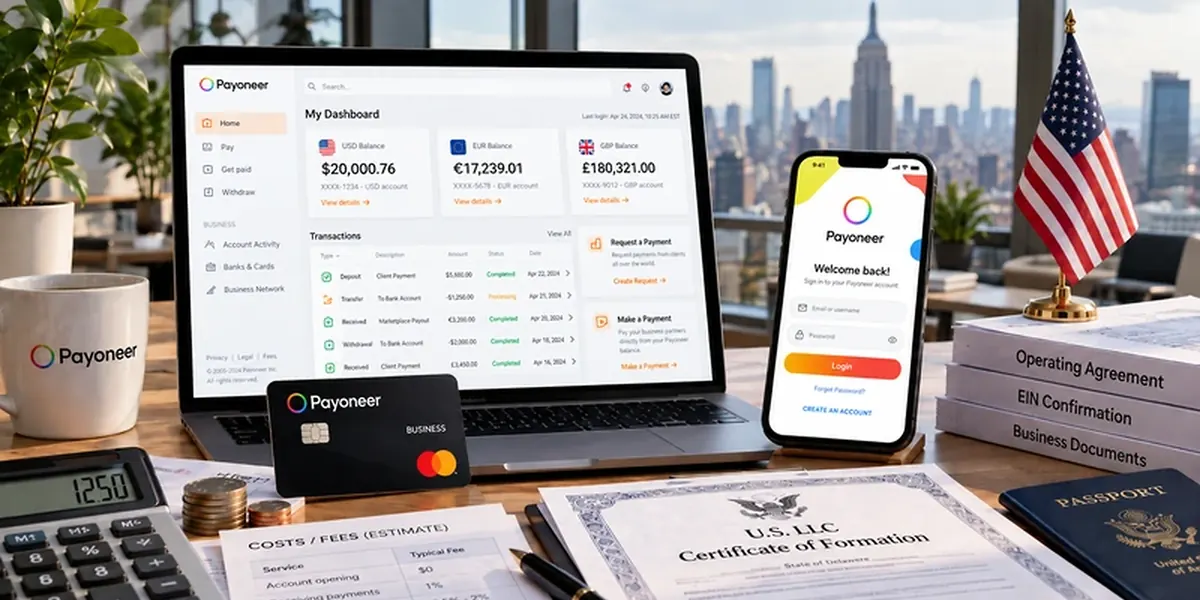
The image above is AI-generated. The balances, dates and prices shown in it are examples, not real Payoneer data.
What Payoneer is, and what it is not
Payoneer Inc. describes itself as a Money Service Business registered with FinCEN and a licensed money transmitter under the laws of various U.S. states, according to its referral program terms. That is a different category from a bank:
- It moves and holds customer funds. It is a payments platform, not an account with a chartered bank.
- A balance is not automatically an insured deposit. The FDIC explains that when a nonbank company deposits your funds at a bank, “pass-through” insurance may apply only if certain conditions are met, and that it does not protect against the insolvency of the nonbank company itself. See the FDIC guide to third-party apps.
For the main account of the LLC, read our guide on opening a U.S. business bank account as a non-resident.
How it works for an LLC owned from abroad
A Payoneer receiving account gives your business local account details in a specific country and currency. A client pays by local bank transfer, such as ACH in the U.S. or BACS in the UK, or by SWIFT wire, and the money lands in your Payoneer balance (Payoneer receiving accounts).
For example, a U.S. client pays an invoice by ACH to your USD details, and a UK agency pays in pounds to your GBP details. Each amount stays in its own currency until you convert it or withdraw it.
Avoid withdrawing company money to a personal account. Mixing personal and business funds weakens the separation that protects the owner: see what LLC liability protection covers.
Who can pay you
Payoneer’s terms and conditions (September 2026 version, section 6.1) say its billing tools are for commercial business transactions, and that using them to get paid for goods or services sold to consumers is strictly forbidden. Its payment request page adds that the tool is not a checkout for an online store. Once you receive payments, Payoneer may review their nature (information for receivers).
In practice, business clients paying an invoice and marketplaces paying out your revenue are supported through these tools. Private customers buying from your online store are not.
Payoneer lists a separate product for online stores, Payoneer Checkout, on its business payments page. Availability depends on eligibility. If you sell mainly to consumers, ask Payoneer whether it fits, or use a payment processor connected to a U.S. business bank account. Our overview of U.S. payment systems compares the options.
What Payoneer costs
Payoneer states that fees for receiving accounts vary by country and currency, and that each customer can see the exact schedule inside their account. The table shows published standard U.S. pricing as summarized by an independent review from July 2026 and other reviewers. Treat it as an example, not a quote.
| Item | Typical published fee |
|---|---|
| Bank transfer to a receiving account in your profile’s local currency | Free |
| Bank transfer to a receiving account in another currency | 1% |
| ACH debit requested from a U.S. client | 1% |
| Credit card payment request | Up to 3.99%, plus 0.49 USD in some countries |
| Conversion between Payoneer balances | 0.5% |
| USD withdrawal to a U.S. bank account in USD | 1.50 USD below 50,000 USD a month, reported for some accounts |
| Annual account fee | 29.95 USD, see below |
For example, if a U.S. client pays a 1,000 USD invoice by ACH debit, the fee is 1%, which is 10 USD. Your balance receives 990 USD.
The annual fee can apply after the first 12 months. Payoneer’s FAQ on annual fees says it is not charged if you receive more than 6,000 USD (or equivalent) in a consecutive 12-month period, and that your own threshold is shown on the Fees page of your account. Some independent guides cite 2,000 USD for certain accounts, so check yours. The FAQ also says Payoneer notifies customers of fee changes in advance.
Limits and risks
Reviews and holds. Payoneer reviews payments and can approve or decline them (information for payers). It also asks for more documents when your registered details do not match the documents you upload, for example a name or address mismatch (document verification FAQ). Our guide on why platforms reject business accounts covers the common causes.
Not a full business bank account. List what your LLC needs, such as receiving from consumers, paying suppliers or connecting accounting tools, and confirm with Payoneer that each one is supported for your account. Keeping all funds on one platform also means one review can stop your payments.
The Nuvei transaction. In June 2026, Payoneer and Nuvei announced that Nuvei will acquire Payoneer for 7.40 USD per share in cash, a total equity value of about 2.75 billion USD (announcement). In its second-quarter 2026 results, published in August, Payoneer described the transaction as still pending. Follow Payoneer’s notices for any change that affects your account.
Opening a Payoneer account for your LLC
Payoneer’s guidance says to register the LLC and get an EIN first, and that you can open an account once you have the EIN (Payoneer guide). Prepare the formation documents, the EIN confirmation letter, an identity document for the owner, and proof of the company address.
On the address, Payoneer’s guide to registering a company in the U.S. says non-residents cannot use the registered agent address as the company address, and that the company address should be where the business operates. Its verification FAQ says proof of company address must show the company name and the exact address given in the application, and that accepted documents vary by country. Payoneer sets these requirements and can change them, so confirm before you apply. Register the account in the name of the LLC, with details identical to your EIN letter and state records.
You can open the account on Payoneer’s website, or through our Payoneer referral link. MyUSAService takes part in Payoneer’s referral program and may receive a reward if you register through it. Conditions are set by Payoneer’s terms.
Payoneer or a U.S. business bank account
| Your situation | What fits better, in our view |
|---|---|
| Marketplaces or business clients already paying through Payoneer | Payoneer as a collection account |
| Business clients in several countries and currencies | Payoneer next to a U.S. business bank account |
| Mostly U.S. clients paying by bank transfer | U.S. business bank account, Payoneer optional |
| Sales to consumers | U.S. business bank account with a payment processor |
| Large balances to keep | U.S. business bank account |
How MyUSAService helps
MyUSAService forms U.S. companies for owners abroad, obtains the EIN and provides a physical business address in Miami with mail management, at $39 per month. Support for opening your business bank account is included, with a screen-sharing session on Zoom. Prices as of September 2026.
Payoneer is one of the options we discuss with clients, next to U.S. business bank accounts. We cannot guarantee approval by any provider: each one decides with its own rules.
Frequently asked questions
Is Payoneer a bank?
No. Payoneer Inc. describes itself as a Money Service Business registered with FinCEN and a licensed money transmitter. Balances are not automatically FDIC-insured deposits, and FDIC pass-through insurance does not protect against the insolvency of a nonbank company.
Can I get paid by private customers on Payoneer?
Not through its billing tools. Payoneer’s terms forbid using them for sales to consumers, and the payment request tool is not a checkout for an online store. Payoneer lists a separate product, Payoneer Checkout, subject to eligibility.
Can a non-resident open a Payoneer account for a U.S. LLC?
Payoneer says you need the LLC and the EIN first. It verifies the company and its owner, and approval is decided by Payoneer.
Does Payoneer charge an annual fee?
It can, after the first 12 months. Payoneer’s FAQ says the fee is not charged if you receive more than 6,000 USD (or equivalent) in a consecutive 12-month period. Your own threshold appears in your account.
Can Payoneer replace my U.S. business bank account?
For most LLCs, it works better next to a bank account than instead of one. It suits collections from business clients and marketplaces. Check that it supports every service your company needs.
Considering Payoneer for your U.S. LLC?
Talk for 30 minutes, free of charge, with a MyUSAService consultant.
- No obligation
- Consultation in English
- 30 minutes
- We check whether it fits your situation
Sources
- Payoneer Inc., Terms and Conditions (September 2026 version), section 6.1
- Payoneer, Request a payment
- Payoneer Help, Request a payment: information for receivers
- Payoneer Help, How to pay a Payoneer user: information for payers
- Payoneer, Multi-currency receiving accounts
- Payoneer Help, FAQ: Annual fees
- Payoneer, Refer Your Network Terms of Use
- Payoneer, Registering your company in the US
- Payoneer, Alternative to opening a business bank account in the US
- Payoneer Help, Document verification FAQ
- Payoneer, Business payment services (Payoneer Checkout)
- Nuvei and Payoneer, Nuvei to acquire Payoneer (June 15, 2026)
- Payoneer, Second quarter 2026 financial results
- FDIC, Banking with third-party apps
- Dodo Payments, Payoneer fees explained (independent summary, July 2026)
First published September 29, 2026. This article is general information, not tax advice for your situation. U.S. business bank account | Book a free call

 How to Open a U.S. Business Bank Account as a Non-Resident
 Why Stripe, PayPal and Mercury Reject Business Accounts
 U.S. Payment Systems for International Entrepreneurs
 International Transfer Fees: How to Compare and Cut Costs