The short answer
- Business credit is a separate record, kept by credit reporting companies, of how a company pays its obligations. It is not the same as personal credit.
- The SBA suggests registering for a DUNS number, a unique nine-digit identifier for each physical location of a business, from Dun & Bradstreet.
- The SBA says that company credit reports can be obtained from Experian, Equifax, Dun & Bradstreet or smaller reporting services, and that both personal and business credit should be monitored.
- For a new business, lenders typically look at the owner's personal credit first, because the company has no record yet.
- The base of business credit is a formed company, an EIN, a business bank account and bills paid on time.
Table of contents
Credit decides how easily a company can rent an office, buy from suppliers on payment terms, obtain a card or borrow. For a founder abroad, the challenge is that a new U.S. company has no credit record at all. Business credit is built step by step, and the first steps are the least glamorous.
Business credit and personal credit
Personal credit is the record of how an individual pays. Business credit is the record of how a company pays. Credit reporting companies keep both. The SBA notes that a new business has no financial history, and that loan eligibility for a new business is typically based on its owner’s personal credit. Over time, a company that pays on time builds its own record.
That is one reason to keep the company’s money and the owner’s money separate: a company that is treated as a separate entity is easier to assess.
Step by step
- Form the company. An LLC or corporation, in good standing. See the best state to form an LLC and our guide to compliance.
- Get an EIN. It identifies the company to banks, suppliers and the IRS.
- Open a U.S. business bank account. See how to open one as a non-resident.
- Use consistent company details everywhere: name, address and phone.
- Register for a DUNS number. The SBA recommends it as one of the first steps: it is a unique nine-digit identifier that Dun & Bradstreet assigns to each physical location of a business.
- Start with small obligations. A supplier account with payment terms, or a secured card, that reports to credit reporting companies. See our guide to business credit cards.
- Pay on time, every time. Payment history is the base of every credit record.
- Monitor the reports. The SBA says to monitor both personal and business credit, and that a company can obtain its report from Experian, Equifax, Dun & Bradstreet or smaller reporting services.
What slows credit down
- Mixing personal and business spending.
- Different addresses or names on different accounts.
- Paying late, even by a few days.
- Opening many accounts at once.
- Relying on accounts that do not report to credit reporting companies.
Keep records
Credit reports reflect what you do, and your books show why. Reconcile every account each month: our bookkeeping guide explains the routine. Yearly costs of the company also affect cash flow: see the hidden costs of a U.S. LLC.
What to expect
Building business credit takes months, not days. There is no shortcut that a serious lender will not see through. Be wary of anyone who promises fast credit scores in exchange for a fee, and check what a service really reports and to whom.
What MyUSAService offers
MyUSAService forms U.S. companies for owners abroad, obtains the EIN and supports the opening of a business bank account. The Startup package costs $2,200, with state fees included in the first year for Florida and Wyoming. Prices as of September 2026. We do not provide credit or credit repair services.
Frequently asked questions
What is business credit?
A record, kept by credit reporting companies, of how a company pays its obligations. It is separate from personal credit.
How do I start building business credit as a foreign founder?
Form the company, get an EIN, open a U.S. business bank account, register for a DUNS number, and start with small obligations that report to credit reporting companies.
What is a DUNS number?
A unique nine-digit identifier assigned by Dun & Bradstreet to each physical location of a business.
How long does it take?
Months, and it depends on what you use and how consistently you pay.
Do lenders look at my personal credit?
For a new business, typically yes. A young company has no record of its own.
Want to build U.S. business credit from abroad?
Talk for 30 minutes, free of charge, with a MyUSAService consultant.
- No obligation
- Consultation in English
- 30 minutes
- We outline the first steps for your company
Sources
First published July 14, 2025. This article is general information, not tax advice for your situation. MyUSAService packages and prices | Book a free call

 U.S. Business Credit Card for Foreign-Owned Companies
 How to Open a U.S. Business Bank Account as a Non-Resident
 Bookkeeping Services in the USA for Foreign-Owned LLCs
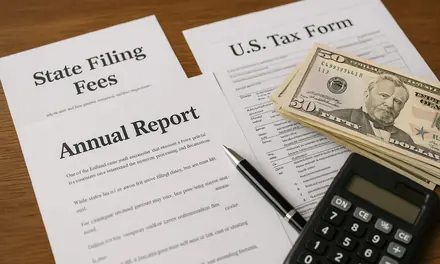 Hidden Costs of a U.S. LLC for International Entrepreneurs